
CELEBRITY
20 minute ago Trump revives tariffs as a weapon, the European Union counters with long-term economic strategy, finalizing a massive Mercosur trade deal that weakens U.S. leverage, reshapes global supply chains, and proves competence beats confrontation.

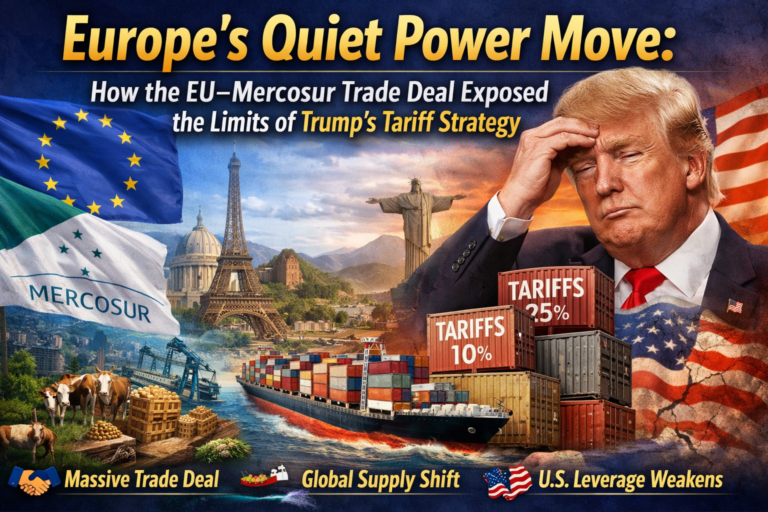
Trump revived his familiar playbook—floating a 10% tariff here, threatening 25% tariffs there—he framed the move as strength. A warning shot. A reminder of American dominance. The targets, once again, were European allies who dared to resist U.S. pressure, whether on trade, policy alignment, or even Trump’s surreal flirtations with the idea of exerting control over Greenland.
But while Trump was busy rattling sabers, the EU did something adults in the room tend to do. They finished the job.
After more than twenty years of negotiations, Europe finalized a massive free trade agreement with Mercosur, the South American trade bloc that includes Argentina, Brazil, Paraguay, and Uruguay. No drama. No spectacle. Just a strategic realignment that quietly reshapes global trade flows.
That timing was not accidental. It was surgical.
For over two decades, the EU–Mercosur deal had stalled on environmental standards, agricultural protections, and political headwinds on both sides of the Atlantic. It survived changes in governments, economic crises, and shifting global priorities. And now—precisely as Washington leans back into tariff threats—it lands.
Trump’s core negotiating assumption has always been that everyone needs the United States more than the United States needs them. That assumption might have held some truth in a unipolar world. It does not hold in a multipolar one.
The EU–Mercosur deal punches directly at that belief.
With diversified access to food, energy, and manufacturing inputs from another hemisphere, Europe becomes far less sensitive to U.S. trade pressure. Tariffs that might once have stung now land with a dull thud. The cost doesn’t disappear—but it’s spread, absorbed, and mitigated.
And for Trump’s tariff strategy? It means diminished leverage.
That’s the part often missed in headline-driven coverage. Tariffs don’t operate in a vacuum. They only work when the target has nowhere else to go. The moment alternatives exist—real, scalable alternatives—the threat loses its edge.
This is what tariff fatigue looks like in practice. Countries don’t retaliate loudly. They don’t escalate in public. They simply adjust. They sign new deals. They build parallel supply chains. They reduce exposure. And once that shift happens, it’s rarely reverse.
regulatory alignment, and long-term market access. One approach generates applause at rallies. The other reshapes the global economy.
This isn’t about symbolism. It’s about math. When the next round of tariffs hits, Europe will feel the impact—but far less than Washington expects. The pain will be diffused across a broader network of partners. The leverage Trump believes he holds will be thinner, weaker, and easier to ignore.



JUST IN; United States Secret Service Announces It Has Foiled a Sophisticated Assassination Attempt Targeting Donald Trump, Allegedly Planned as Retaliation for the Death of Iran Supreme Leader Ayatollah Ali Khamenei amid ongoing war
Fans Can’t Stop Talking About These 5 New Serena Williams Private Photos in Military Camo Showcasing a Humongous Backside – But Photo No. 3 Reveals More Clear Details When She Tried On the Semi-Transparent One, Showing She Wasn’t Wearing Anything Underneath…

Breaking:Paris Jackson stuns in sheer flowy dress for glitzy bash amid legal war over Michael Jackson’s estate

Breaking:Iran’s Supreme Leader killed in joint US Israeli strikes, Trump says…

💔 HEARTBREAKING NEWS: Angelina Jolie Rushed to Hospital With a “Severe” Illness — Doctors Admit They’ve Never Seen a Case Like This Before… 😭 🔔 Read more :

BREAKING NEWS: Former U.S. President Barack Obama Has Just Been Confirmed… See Full Details👇👇

BREAKING NEWS — **Donald Trump calls for regime change in Iran as the United States and Israel unleash massive, coordinated strikes, triggering global alarm, Middle East airspace shutdowns, and fears of a wider regional war with worldwide economic consequences…See more

🚨🇮🇷 Reports of further explosions are coming out of Kuwait and Abu Dhabi as Iran continues its retaliatory strikes on U.S targets in the region, see videos of affected regions here…

JUST IN: 🇮🇷🇮🇱 Iranian Defense Minister Amir Nasirzadeh killed in Israeli attack. With reports that Putin has ordered a retailation against USA. The war has escalated beyond control with Trump…READ MORE HERE…

JUST IN:USS Mason Took a Direct Strike – The Response Came Faster Than Anyone Expected.Read more in the link below

Breaking News: 🇮🇷 Iranian officials just confirmed intel that suggests U.S. strikes against Iran will be sustained against multiple major cities across the nation.
