NEWS
Trending News: Supreme Court Appears Poised to Weaken Voting Rights Act.Imagine!!!! In this generational

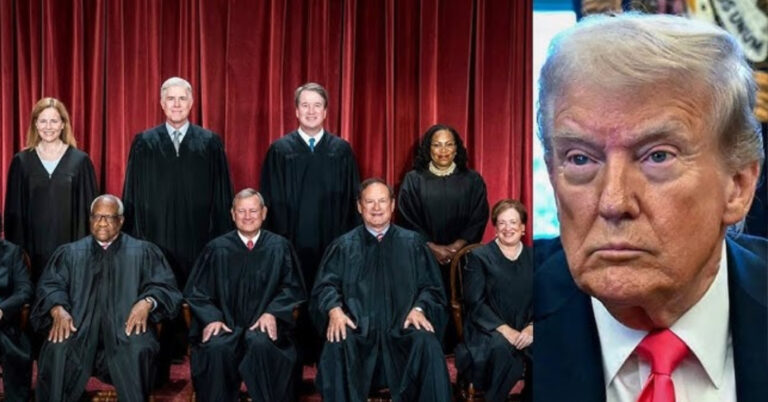
The U.S. Supreme Court seems ready to impose stricter controls on the enforcement of Section 2 of the Voting Rights Act by federal courts, which could protect state lawmakers from challenges that mix race and partisanship in the redistricting process.
The impending decision carries immense weight, with two prominent voting rights organizations cautioning that the removal or restriction of Section 2 could empower Republican-led legislatures to manipulate the boundaries of as many as 19 congressional districts to their advantage.
In a recent interview on “Fox & Friends,” attorney Mehek Cooke shared her insights with host Kevin Corke, expressing her belief that the Supreme Court is providing President Donald Trump with a strategic “road map” for handling key cases that could significantly influence his agenda.
In the re-arguments of Louisiana v. Callais, a conservative majority expressed a willingness to consider an approach supported by the Trump Justice Department. This could complicate the ability of plaintiffs to succeed in claims of racial vote dilution in areas where voting patterns closely mirror party affiliations—a defining characteristic of contemporary Southern politics.
The situation arises from Louisiana’s 2022 congressional map, which a federal district court has found likely to violate Section 2 by funneling Black voters—who represent approximately one-third of the state’s population—into a single majority-Black district out of a total of six.
In 2024, lawmakers took action by adopting a remedial plan that established a second district of this kind. However, white voters took legal action, claiming that the adjustments constituted an unconstitutional racial gerrymander, and a district judge ruled in their favor.
The case, initially presented in March, has returned as the justices have requested new briefs regarding the constitutionality of Section 2.
This summer, Louisiana changed its position, now advocating for the Court to restrict or abolish race-conscious districting. Black voters who launched the initial challenge stood by the remedial map, asserting that it effectively addresses the documented dilution of minority voting power.
The U.S. Supreme Court is on the brink of a ruling that may abolish congressional districts defined by race.
Conservative justices displayed hesitation to completely overturn Section 2, a provision established in 1965 and reinforced in 1982 to prevent practices that deny minorities equal access to the electoral process.
Instead, they focused on a more specific theory presented by Principal Deputy Solicitor General Hashim Mooppan, who represented the Trump administration.
In reference to the 2019 Rucho v. Common Cause decision, which prevented federal courts from intervening in partisan gerrymandering, Mooppan contended that states could justify their maps by citing valid partisan objectives, even when these objectives intersect with racial demographics.
This would enable mapmakers to emphasize Republican strengths, for example, without violating Section 2, provided the intent isn’t solely racial.
Chief Justice John Roberts, the author of the 2023 Allen v. Milligan ruling that requires the establishment of a second majority-Black district in Alabama, examined whether this framework is consistent with Allen and the Court’s Thornburg v. Gingles criteria.
The test mandates that plaintiffs demonstrate a minority group is not only sizable and cohesive but also experiences majority bloc voting that undermines their electoral candidates. Roberts appeared focused on aligning the proposal with established norms, steering clear of a complete transformation.
Justice Brett Kavanaugh, an influential voice in the Allen case alongside Roberts and the liberal justices, raised the possibility of a “sunset” clause for Section 2 remedies, referencing precedents that restrict race-based policies to temporary solutions.
Fairness Samuel Alito explored the concept of “congruence and proportionality” in the context of the interplay between race and party affiliation, voicing apprehension about potential judicial overreach in politically sensitive matters.
Voting rights organizations aligned with the Democratic Party are gearing up for what they anticipate could be a significant crisis if the U.S. Supreme Court undermines a crucial element of the Voting Rights Act, a cornerstone of civil rights legislation in the nation.
Two prominent voting rights organizations cautioned that the removal or restriction of Section 2 could empower Republican-led legislatures to manipulate the boundaries of as many as 19 congressional districts to their advantage.
Fair Fight Action and the Black Voters Matter Fund have collaborated on a fresh analysis, exclusively shared with POLITICO. If Section 2 of the Voting Rights Act is invalidated, it could significantly increase the likelihood of Republicans maintaining control over the House of Representatives.
The authors of the paper assert that a verdict before next year’s midterm elections remains a possibility, albeit an unlikely one.
Research has identified 27 congressional seats nationwide that could be redrawn to benefit Republicans, contingent on the current legal and political landscape remaining unchanged.
Nineteen of these changes are directly tied to the potential loss of Section 2 protections.





Serena Williams Turns Heads With Beach Moment That Sparks Massive Reactions

BREAKING NEWS IN WASHINGTON DC: U.S. President Donald Trump Has Just Been Confirmed… See More👇👇

BREAKING: “Alysa Liu Drops Bombshell Pictures With Taylor Swift and Travis kelce- you Wont Believe This Amazing amd Incredible 2026 Cam Shot”
JUST IN: U.S. Former President Joe Biden Has… See More👇👇

These 5 private Serena Williams mouth-watering beach photos are causing serious damage to fans, and the photos have now been deleted. See them before they get deleted.

Breaking:💔 If i Never Invited Him… Maybe He’d Still Be Here.” See Reason for the invite here…
JUST IN; United States Secret Service Announces It Has Foiled a Sophisticated Assassination Attempt Targeting Donald Trump, Allegedly Planned as Retaliation for the Death of Iran Supreme Leader Ayatollah Ali Khamenei amid ongoing war
Fans Can’t Stop Talking About These 5 New Serena Williams Private Photos in Military Camo Showcasing a Humongous Backside – But Photo No. 3 Reveals More Clear Details When She Tried On the Semi-Transparent One, Showing She Wasn’t Wearing Anything Underneath…
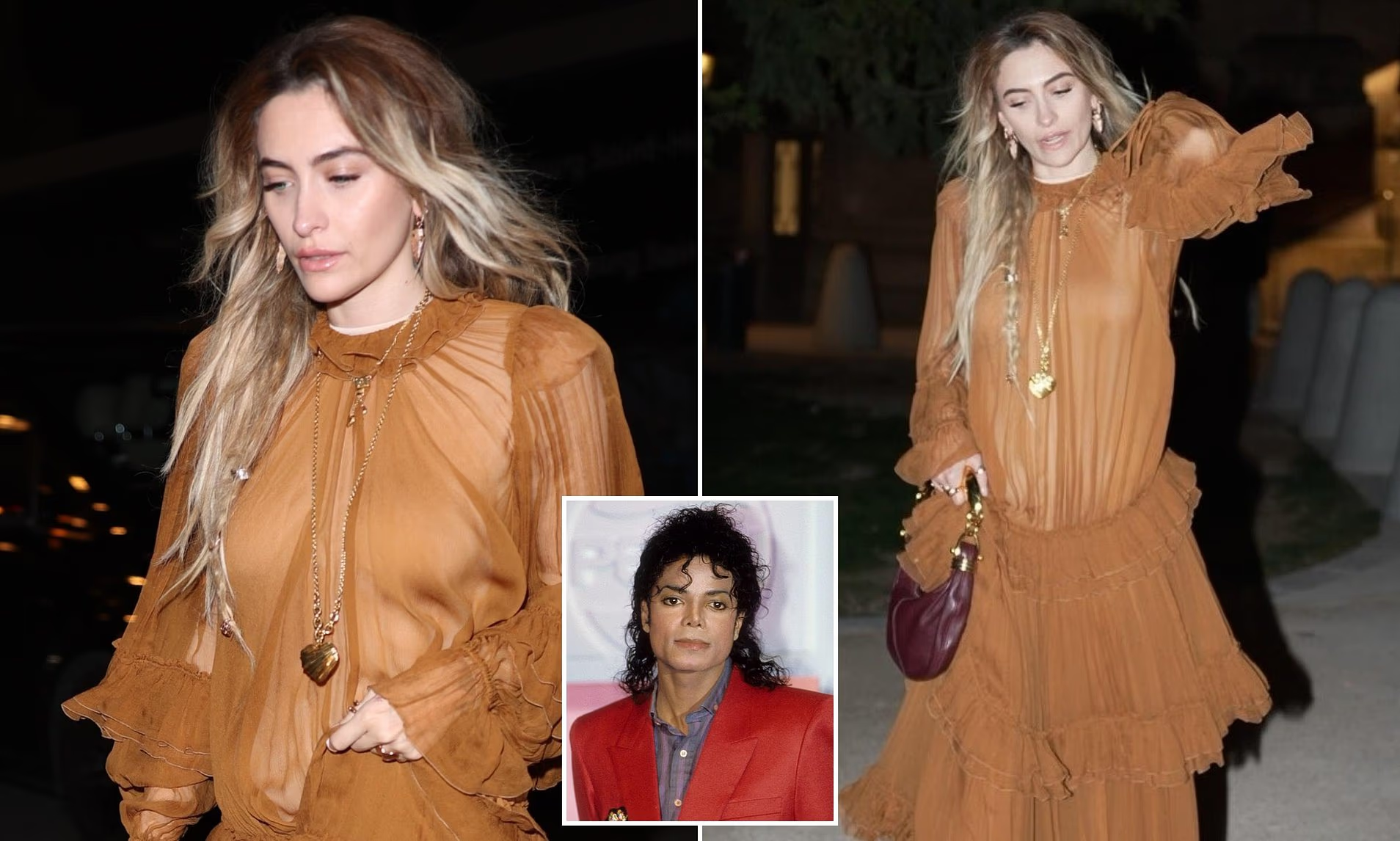
Breaking:Paris Jackson stuns in sheer flowy dress for glitzy bash amid legal war over Michael Jackson’s estate

Breaking:Iran’s Supreme Leader killed in joint US Israeli strikes, Trump says…

💔 HEARTBREAKING NEWS: Angelina Jolie Rushed to Hospital With a “Severe” Illness — Doctors Admit They’ve Never Seen a Case Like This Before… 😭 🔔 Read more :
